❋
September 18, 2026But What About…
Week 4What I’ve Made & Done
Call with Potential Community
On Tuesday I had a ~15 minute phone call with a city clerk about her community and introducing my thesis parameters - I told her the rough timeline for a project (fall) and areas of interest, and she told me about a few challenges and assets of the community that they would be interested in having help with through my project. It sounds like they are quite open to whatever project will fit into my thesis — maybe in the future there would be opportunities for other sorts of projects as well.
One challenge the clerk highlighted was transplants don’t stay long in the community. She said a lot of people drive by the community and don’t think to stop or stay. It has several assets — good restaurants, a wildlife refuge, a few stores, etc. but it is a smaller community and doesn’t have certain resources. A challenge can be bringing people in and also keeping people in the community. It is a close-knit community, but how can we help transplants want to stay longer?
This is an interesting community because it’s within commuting distance of a metro, so it’s attractive in that way, but how do you keep it from being a “bedroom” community? There are families who have lived there for generations, but it’s also changing with people moving in and out.
The call gave me a lot to think about and discuss with my committee! The clerk said I can call her anytime and chat more. It was great to connect with her - thanks to my friend’s mom, Ann, for the connection!
[keep in mind: this phone call was pre-IRB anything]
Exhibition Planning
This weekend, I sat down to begin sketching out my exhibition layout, and it made me start considering: what do I actually want to accomplish with an exhibition? I had visualized having enough work to be able to display in the exhibition as well as a few interactive pieces for people to engage with. However, something felt like it was missing.
As I’ve been researching communities, I’ve been learning more about the concept of Third Spaces — as in, a place to gather or just be that isn’t home or work. It’s just a place you can, like, run into people, talk to someone you don’t know well or who’s a lot different from you, and be in the presence of other people in the same place at the same time. You can also organize gatherings and meetings in these places. Often the essence of a third space is that it’s open to everyone. This obviously varies — a fancy country club is going to be a more exclusive gathering space than a city park, for example. But it gets me thinking about what third spaces are available in rural communities, and what happens when they are shut down.
When I worked on my Scenes from a Small Town project, I selected several institutions that (I didn’t realize at the time) could be thought of as third spaces: library, grocery store, post office. I was talking about how a community seems to lose part of its identity and be in dire straits when it loses places like this. Now I’m realizing that, beyond their obvious purposes of providing groceries, books, and mail service close to home, they serve as informal community gathering spaces.
My exhibition is being hosted at Iowa State, not a rural community, but can I make my exhibition a sort of third space to really drive home the point of how these can build community?
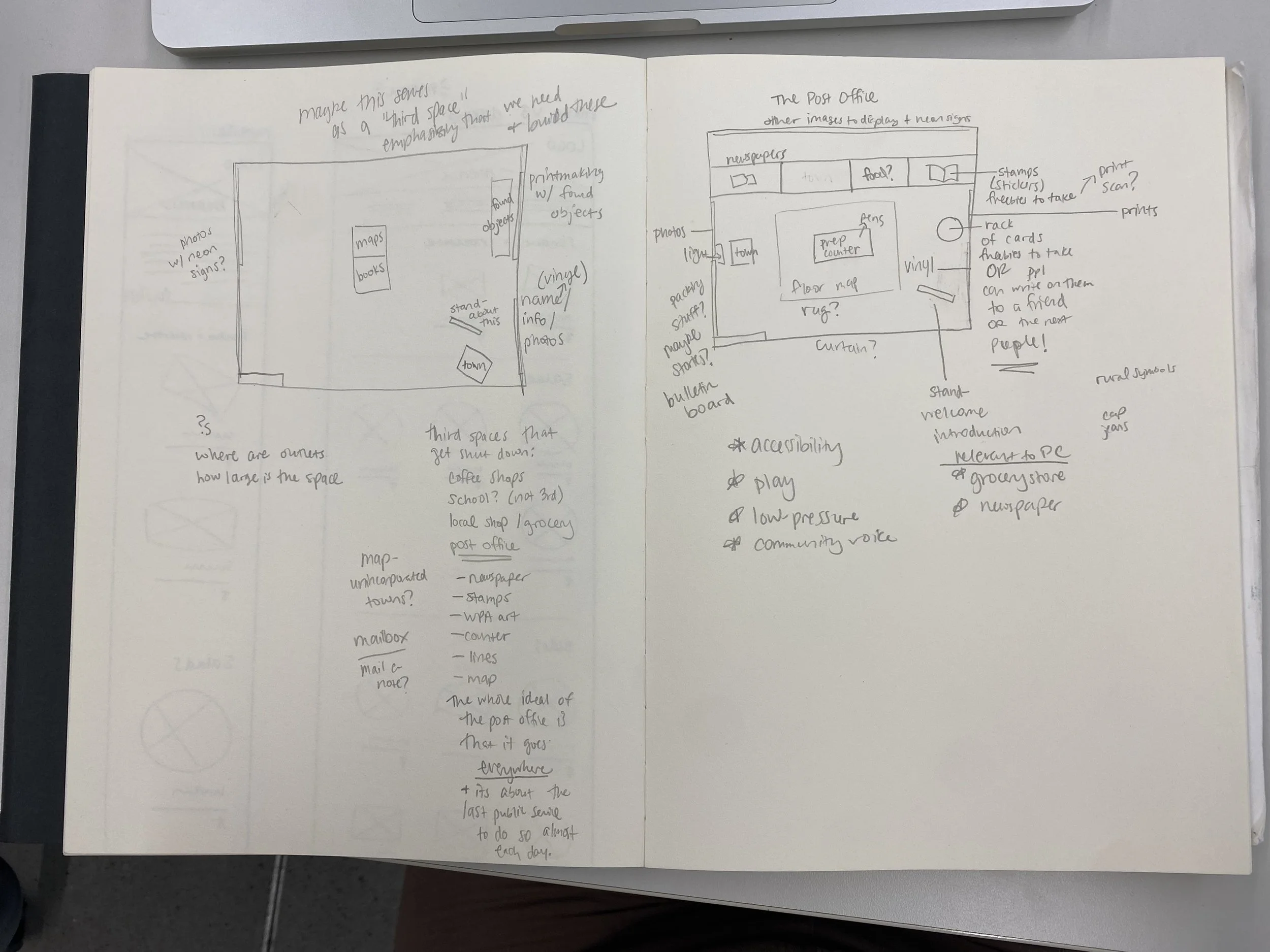
Initial sketching for exhibition space
Side Quest, Sort Of
Taking exhibition brainstorming a step further…what about a post office? I feel kind of crazy for this idea, but isn’t it interesting that a post office is a third space? You might think of it as just a regular federal office building, not super efficient…but that’s what helps make it a third space, AND since our modern definition of efficiency isn’t exactly great for the rural places typically, maybe it’s the perfect illustration of how important these spaces can be and what we lose when we prioritize efficiency over what’s good at building community.
The post office has gotten heat for not being efficient, but it’s also like one of the very few public resources that serve everywhere in the country almost every day. Turns out that service isn’t very efficient when you have people living out in the woods, up in the mountains, and on islands all over the place. BUT I know from my experiences growing up that when a community loses their post office…that can be a bit devastating. Maybe the writing was on the wall; they knew their town was shrinking, we all knew what was coming. But the place a person lives and the community they are part of is often part of their identity (note to self: look up some actual literature on this to reference, I know it’s out there), and the post office can feel like the last nail in the coffin, to unincorporated, to being wiped off the map. The place still exists but its identity to the outside is partially removed. (It also becomes a burden of expense to the county, if I read correctly.) I remember this happening to some nearby towns and the defeat and finality people felt around it.
All this to say, maybe I’ll mimic a post office as third space for my exhibition. Going along with that, I thought I could have people write letters or postcards to the next visitors on designed prints of rural places, an interactive floor map — maybe denoting rural places, or third spaces, or something — and then some snacks, playing cards, newspapers, interactive town, or some other interesting interactive and FUN elements that I’m still thinking on.
Other ideas relevant to PC: The local grocery store, the newspaper
Monotypes, V1
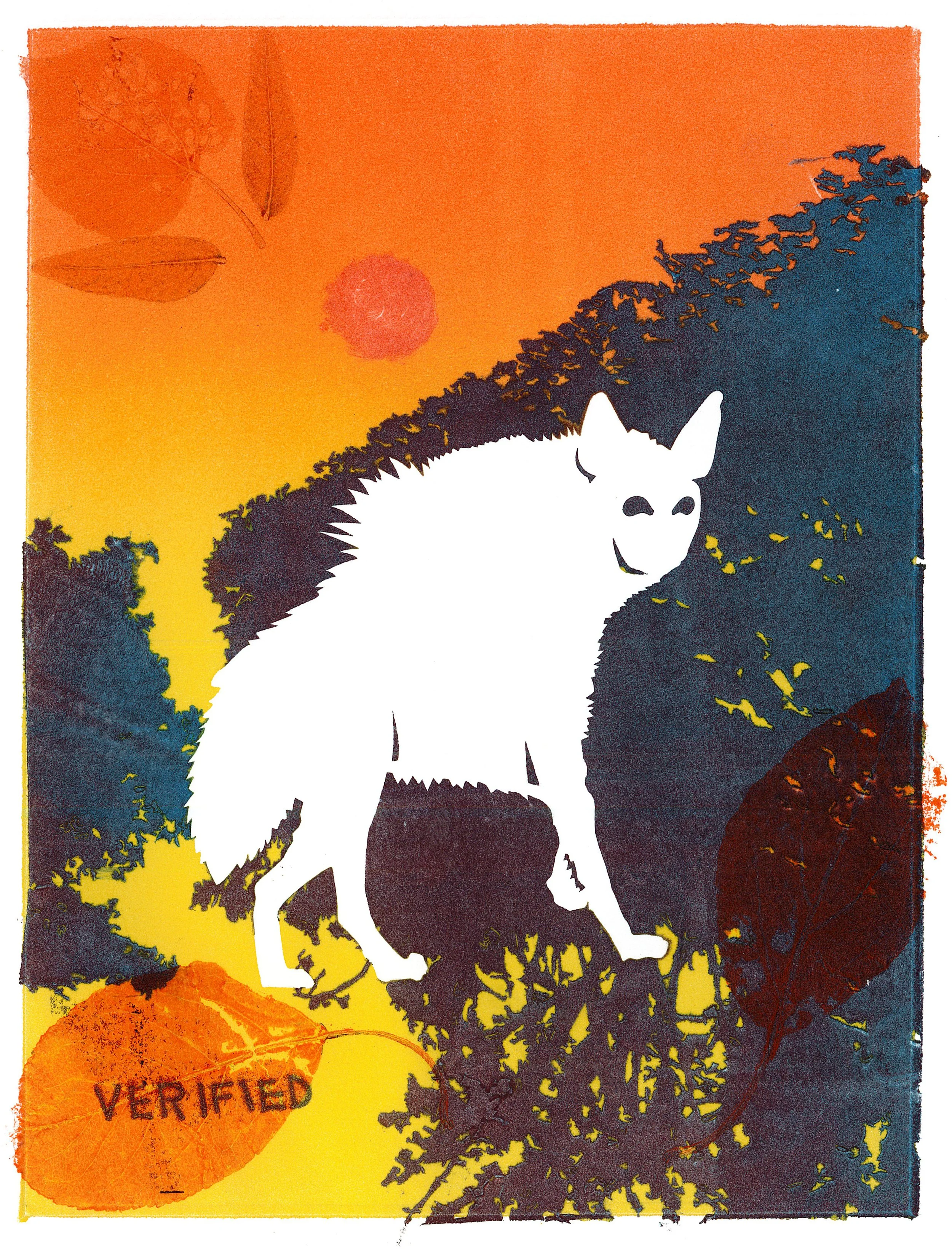
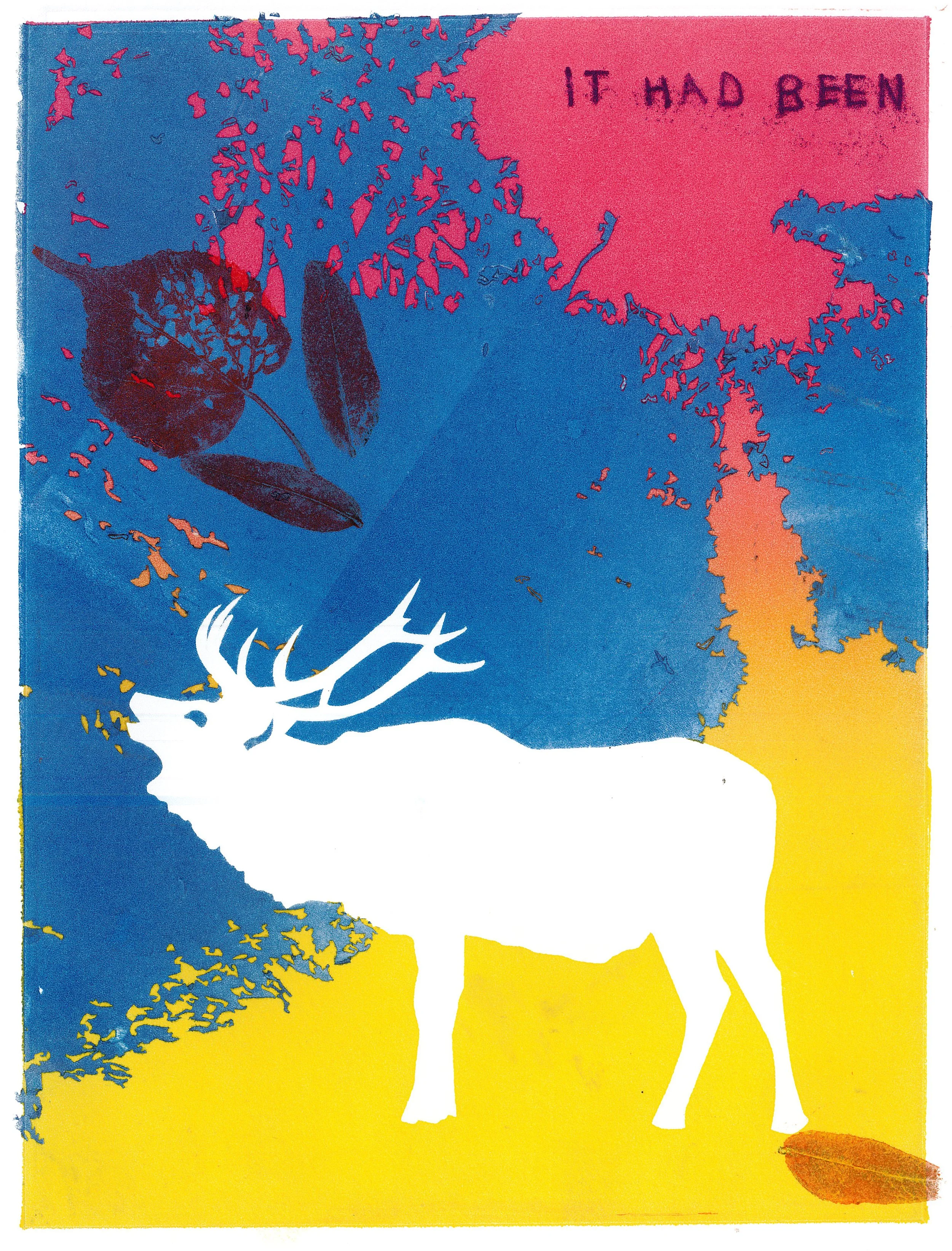
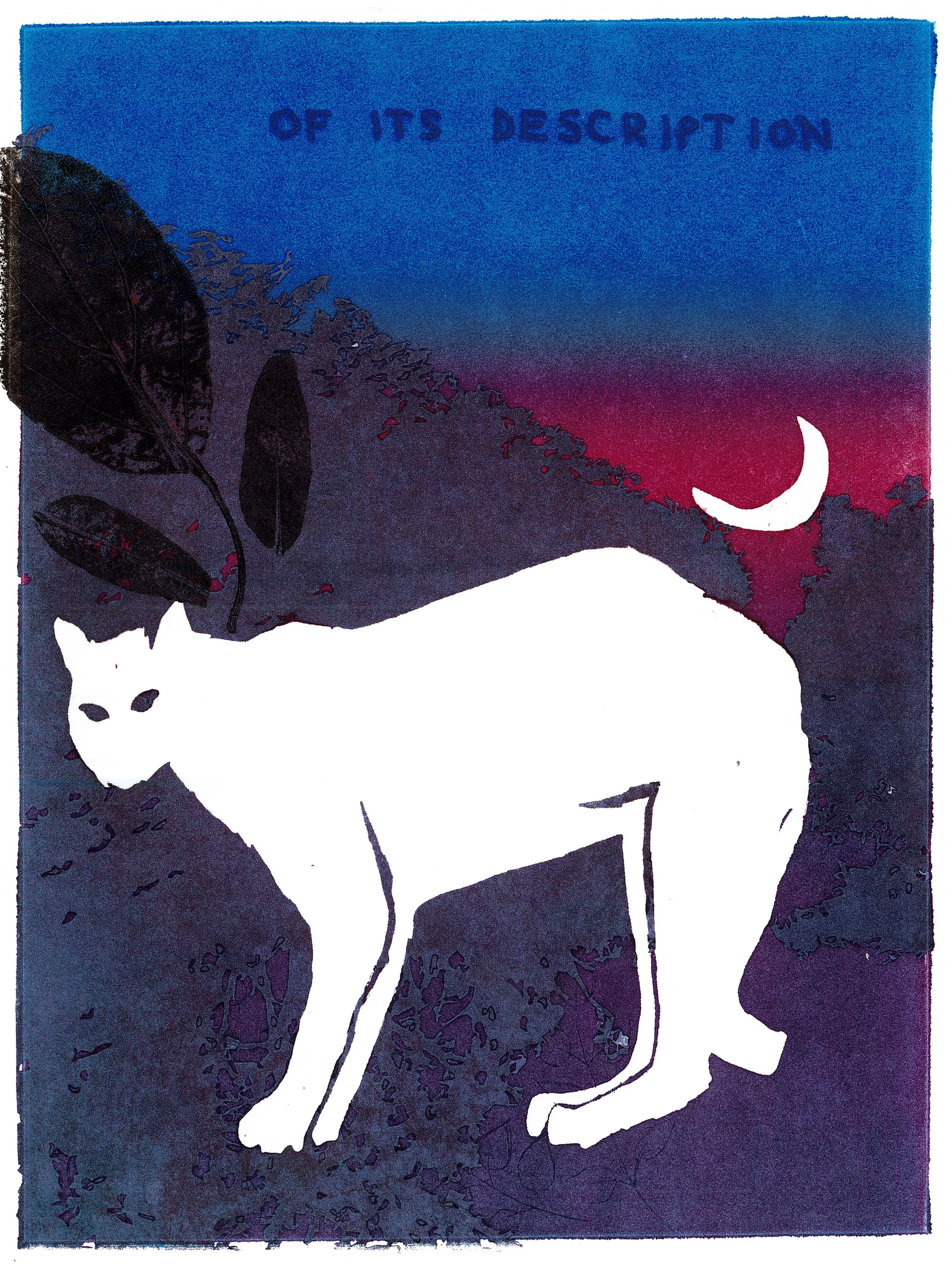
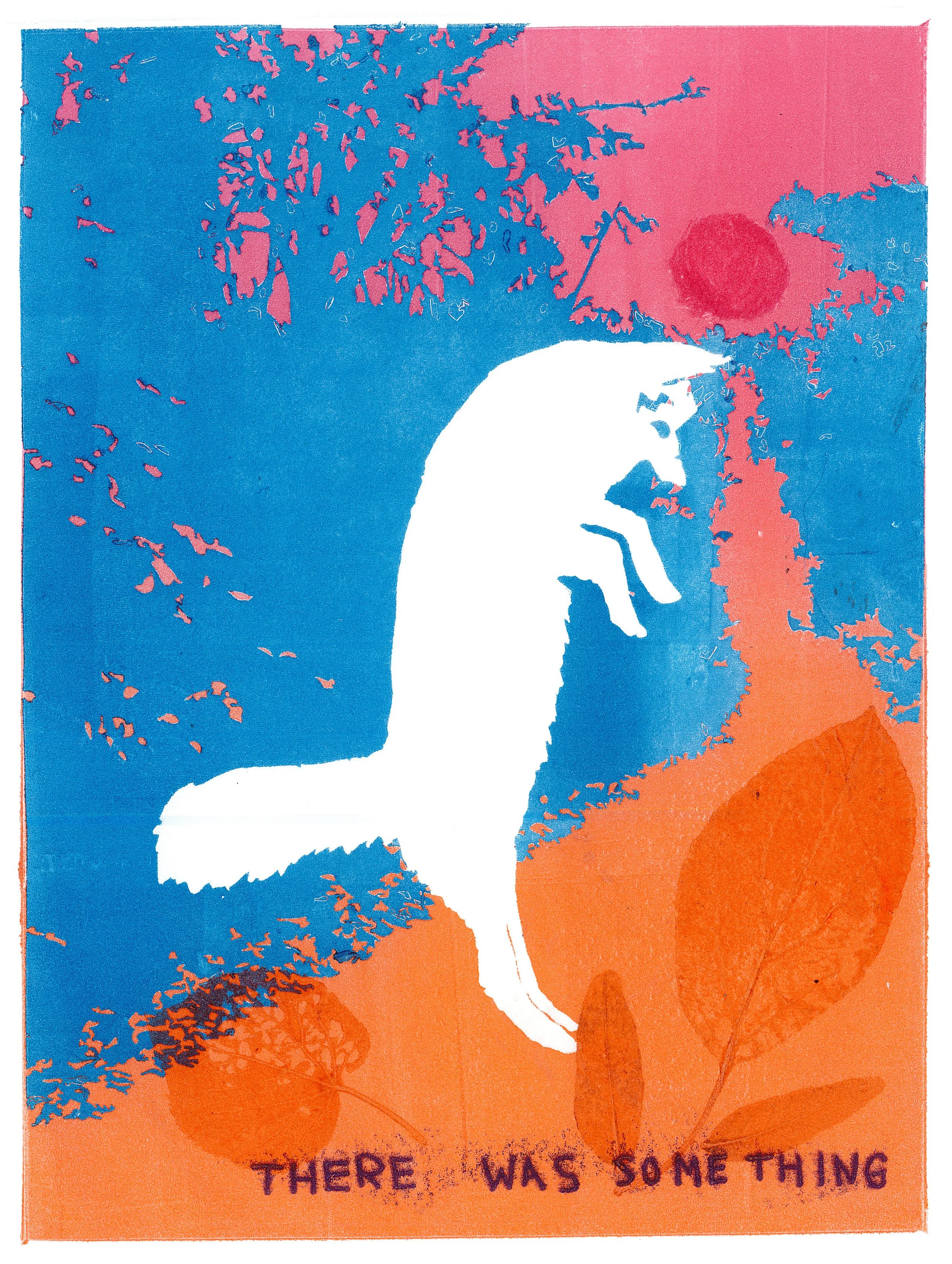
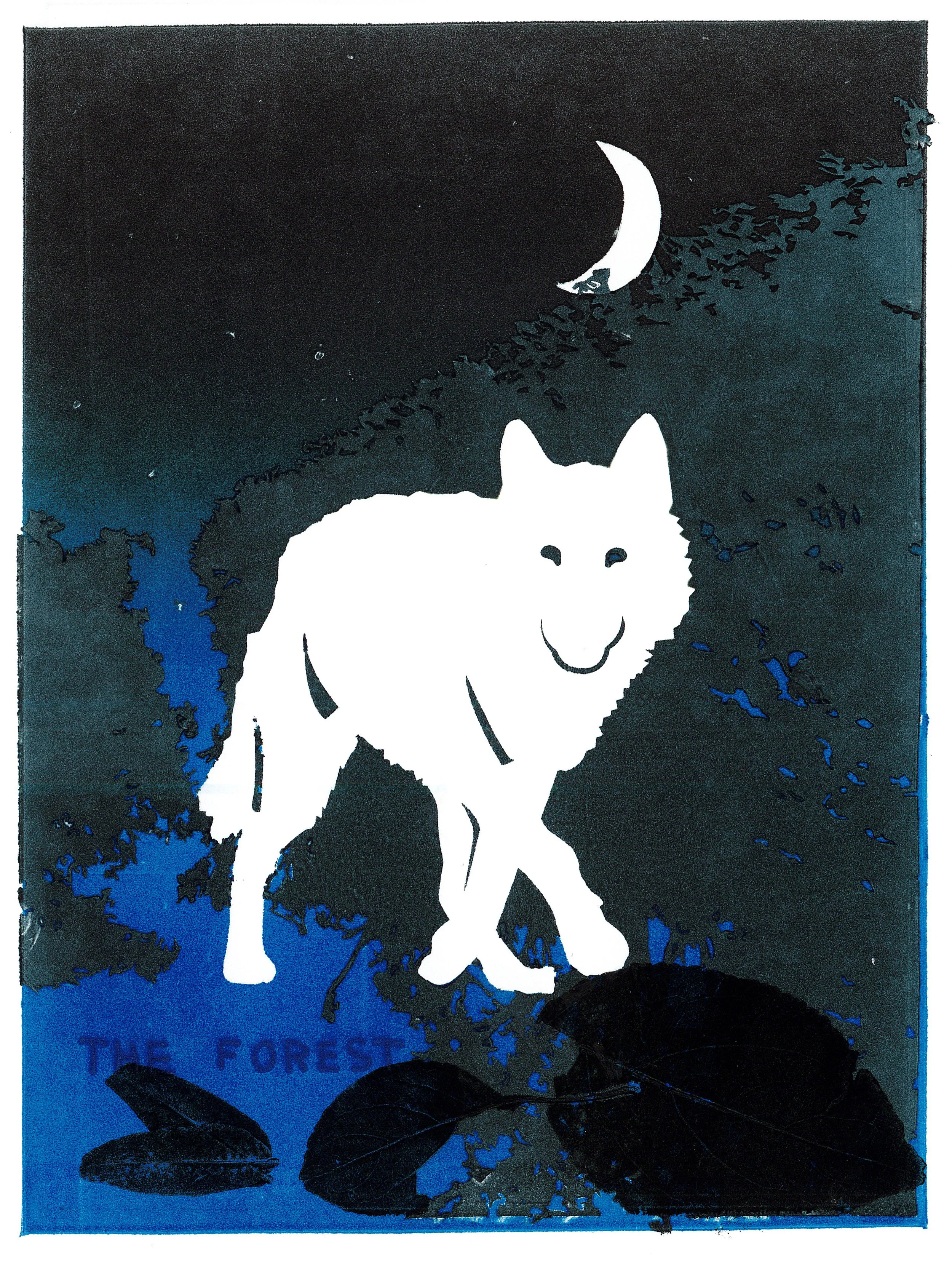
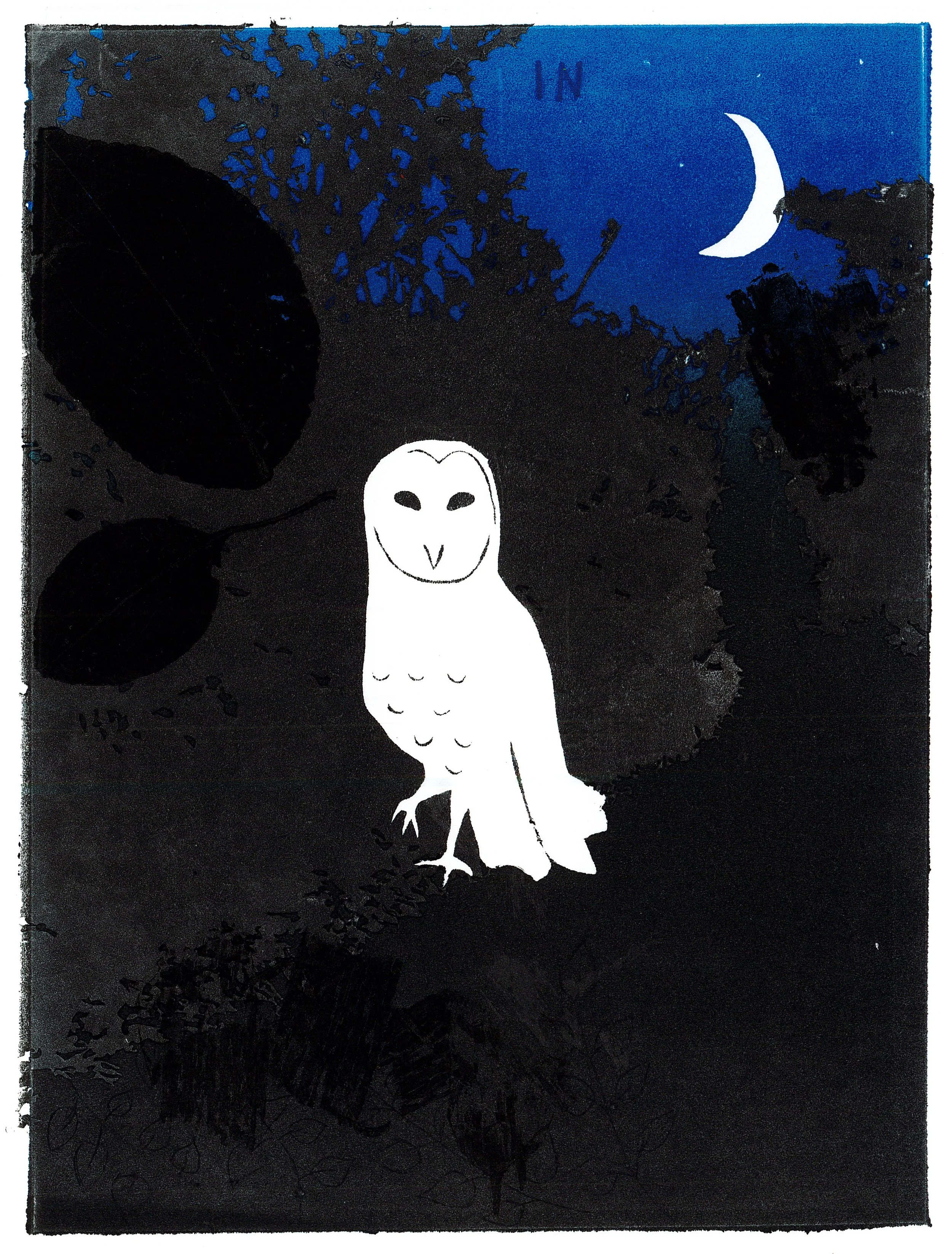
Techniques: Darkfield monotype, laser cut paper stencils, trace monotype, additive layer with found natural objects, rainbow roll
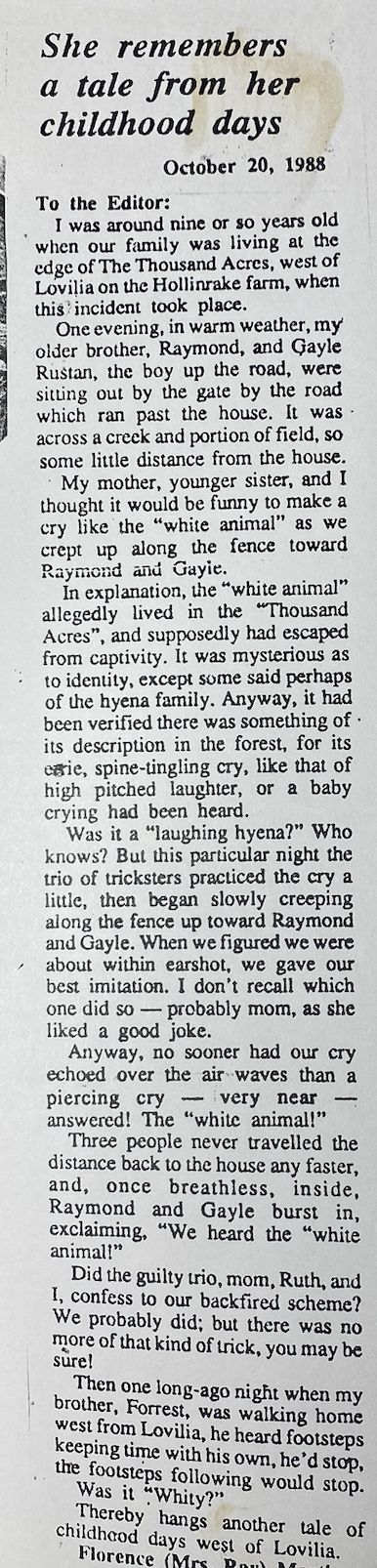
These monotypes, like I talked about in a previous post, are meant to tell the legend of The White Animal, a story my grandma told from rural southern Iowa. Her family lived near the Thousand Acre Woods, and she and her siblings would play pranks on each other by mimicking the wild shrieks of whatever beast was lurking in the forest. Other neighbors knew there was something mysterious living in there as well — some people had described the animal as hyena-esque, but no one seemed to know for sure. I decided to reimagine what The White Animal could have been through six animals that make distinctive hoots, howls, and shrieks. The animals were also selected based on if they live in Iowa or are rare in Iowa — and for the case of the hyena, that just came from my grandma’s writings (but I did learn hyenas may once have roamed in the U.S. Southwest a very long time ago). This gives the work an ecological angle as well.
The woods depicted behind each animal are actually a laser cut stencil from an image-traced photo of the Thousand Acre Woods. I drew each animal and laser cut stencils for each. I found leaves and wood shavings (thanks to my classmate, Kat!) to ink up and print as a sort of “natural debris” to each image of the Woods as a second layer. I learned how to do a rainbow roll to create the sunset and nighttime sky effects — the idea is that it gets later in each scene. I used a trace monotype to add the phrase “It had been verified there was something of its description in the forest,” which is taken directly from an article my grandma wrote about this story in the local paper.
I’m hoping to use these in some form in my exhibition! They could be printed as cards for people to write on or stickers or something cool. I might remake the whole set (once I made it — and this was my first time ever printmaking/monotyping — I thought of a million little things I’d do differently). But I really like the techniques I got to learn for this project and hope to use them more in future prints.
Some feedback I got: Don't be too worried about people obviously seeing every aspect you want them to see. Make people have to look at it, see little details, take in the scene. I can be less intentional in my placement of leaves, wood shavings, words, not covering The White Animal, etc. Consider layering multiple animals and woods/landscapes. Maybe I could use laser cut type or my grandma’s handwriting for the words. The works could go to the edge of the paper. I loved this feedback and am planning a V2.
What I’ve Been reading
Journal articles
Right to the City by David Harvey
When I first read this for my Theories and Constructs of Community Change class, I didn’t think I would log it down for my thesis. However, I keep thinking about it, which must mean it’s relevant, especially when you consider small communities.
There is so much change in small towns even if it doesn't get as much widespread coverage. I also feel that change is felt more deeply in a small town than in larger cities in some ways -- the entire town could be depending on one industry or one school, for example, and if something happens to that then the entire town feels that change. I remember when the Maytag plant closed in Newton, for example, and even with Newton being a larger town that loss still reverberated around Newton and the surrounding smaller towns.
Who has the right to make decisions that affect these places? Who actually is the one(s) making these decisions? Are they the same people?
Harvey, D. (2008). The right to the city. New Left Review, 2(53), 23–40. https://doi.org/10.64590/fmh
The Importance of Third Spaces in Rural Communities
Third spaces work to generate social capital - vitally important in small towns. Rural places are seeing more of a decline in third spaces than urban places. The researchers interviewed Cooperative Extension educators as on-the-ground people involved in small towns.
“These spaces act as anchors of the social dimension of community vitality, bringing together community members to gather, exchange stories and information, and collectively maintain the social fabric of rural towns.”
And if you think these spaces can be replaced by Facebook…not so fast! “Digital spaces certainly provide value, expanding access to social networks, reducing isolation for geographically dispersed residents, and enabling new forms of participation. However, they often lack the deep reciprocity and trust that face-to-face encounters in local gathering spots nurture.”
Third spaces must be regarded as essential: “Protection and preservation can take many forms: Community members can band together to support local businesses, create shared spaces in vacant and underused buildings, or organize social events that bring neighbors together. Meanwhile, leaders can pursue policies that incentivize keeping third places viable, foster local entrepreneurship, and resist the privatization or loss of public gathering spots.”
Third spaces help people feel they truly belong in a community.
Van Leuven A. 2025. "The Importance of Third Places in Rural Communities" Available online at https://www.choicesmagazine.org/choices-magazine/submitted-articles/the-importance-of-third-places-in-rural-communities
DOI: 10.22004/ag.econ.369397
Other media
The Presence of Third Spaces in Less-Dense New York Communities
Focuses on New York City, but I liked the idea of mapping where third places are located.
I also found this quote interesting: “Many of these third spaces are in more urbanized environments, and their presence has motivated younger people to move back into cities.”
So…how can focusing on third spaces in small towns be helpful to retaining people who may want to continue living there, they just aren’t feeling a connection or belonging?
Also urban-focused, but a super-cool zine that highlights different types of third spaces and their value with super-fun design.
Considering this as I plan my exhibition. How can it serve as a third space?
Meeting Notes
I met with Tina this week — it was great to catch up and talk about my thesis direction with her. She thought I could look at existing events in the community to piggy back off of with my project; it makes a lot of sense, since I have a pretty short timeline and I don’t want to try to start a whole new thing from scratch. She also advised that the Iowa State library would have a lot of information about oral histories, if that’s something I end up wanting to collect as part of my project, and she said library staff could likely help me understand what needs IRB approval within the oral history space. Maybe I could even collect oral histories at my exhibit, maybe from visitors’ hometowns? I could include a puzzle as a community activity, maybe even laser cut stamps of third spaces for people to add to postcards? Lots of ideas to explore!
I also discussed with Shawn briefly my direction into exploring third spaces as a challenge & opportunity in the community I plan to work with. He likes the thesis direction and loaned me some books to read up on third spaces!
I also talked with my Soc grad friend Syd about my thesis in third spaces in this community. She suggested a map, or working with the new library on something to help it become more established as a third space, or cool way finding that showed connections between the town’s third spaces and hangout spots.
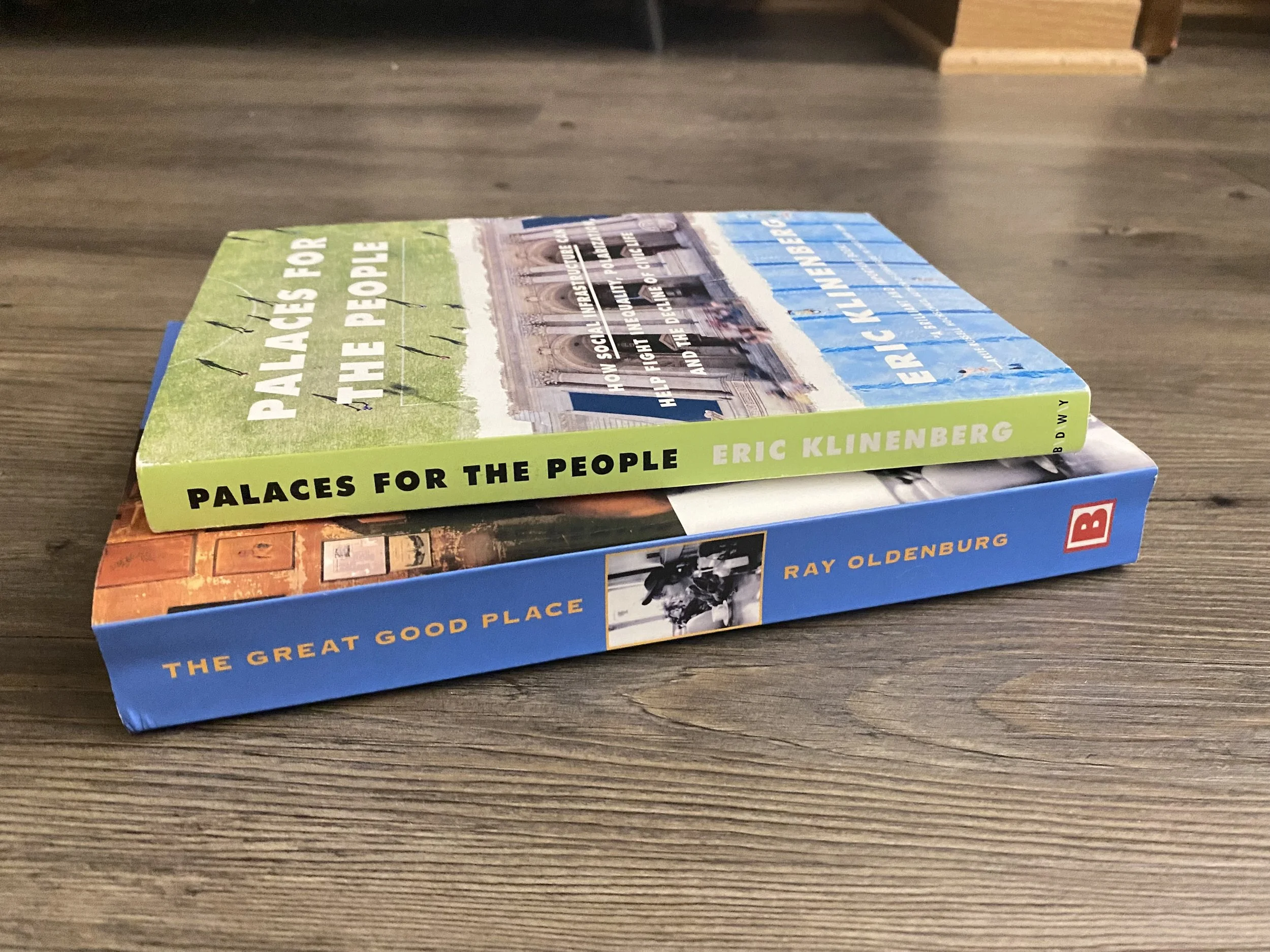
Like I discussed with Tina…we all love watching people in third spaces on TV, right?? They’re where so many moments happen
Up next
Consider project directions and discuss with committee
Call city clerk to talk about project direction & visiting
Figure out IRB requirements - reach out to library, check with committee, look at exemption wizard, figure out what I’m doing
Research community and create community profile
Create video “summary” for Thesis Studio
Sometime soon: figure out when to visit community
Prep for all-committee meeting: scheduled for Sept. 25.