❋
September 4, 2026Getting Situated
Week 2What I’ve Been Making
Thesis Timeline
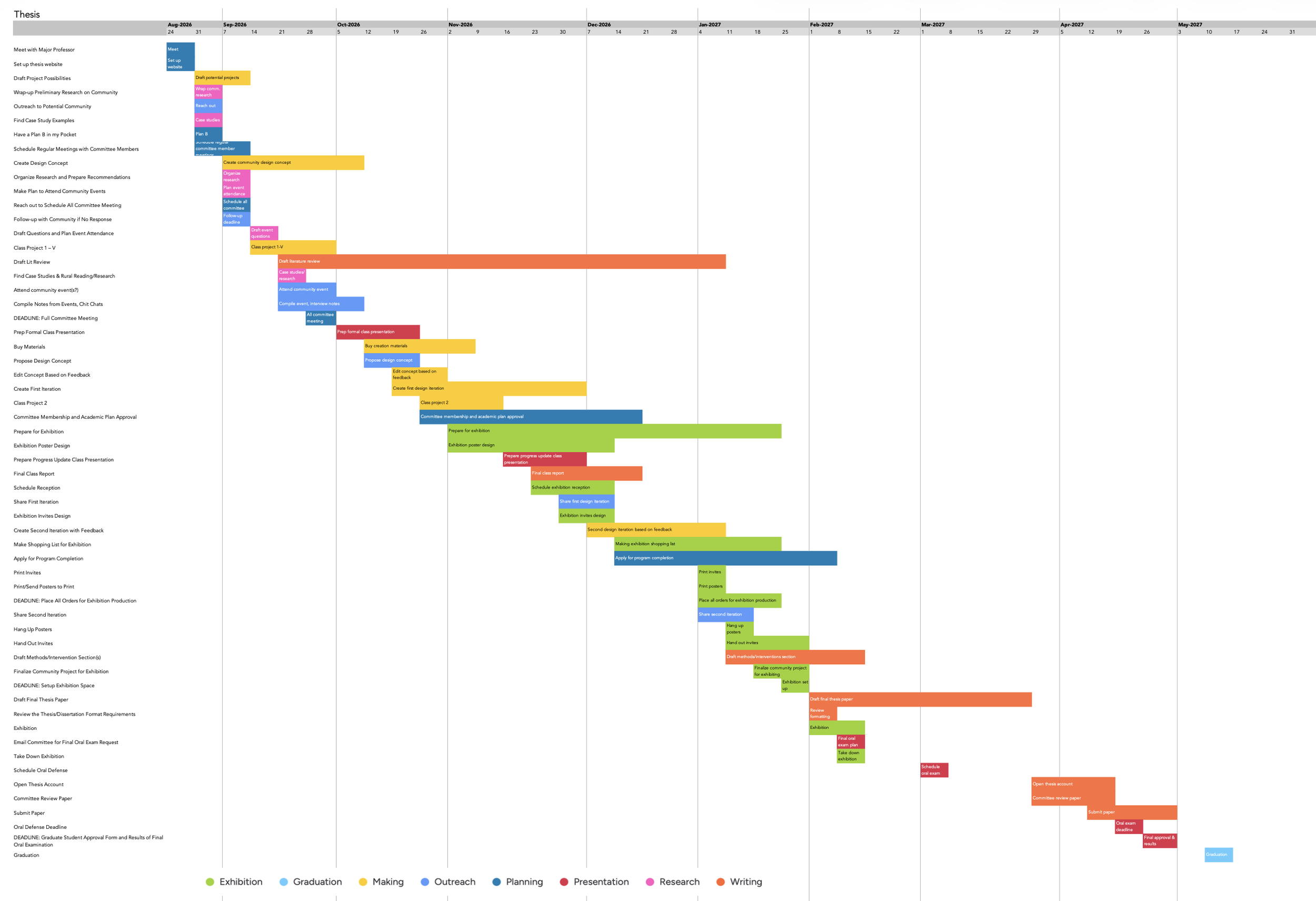
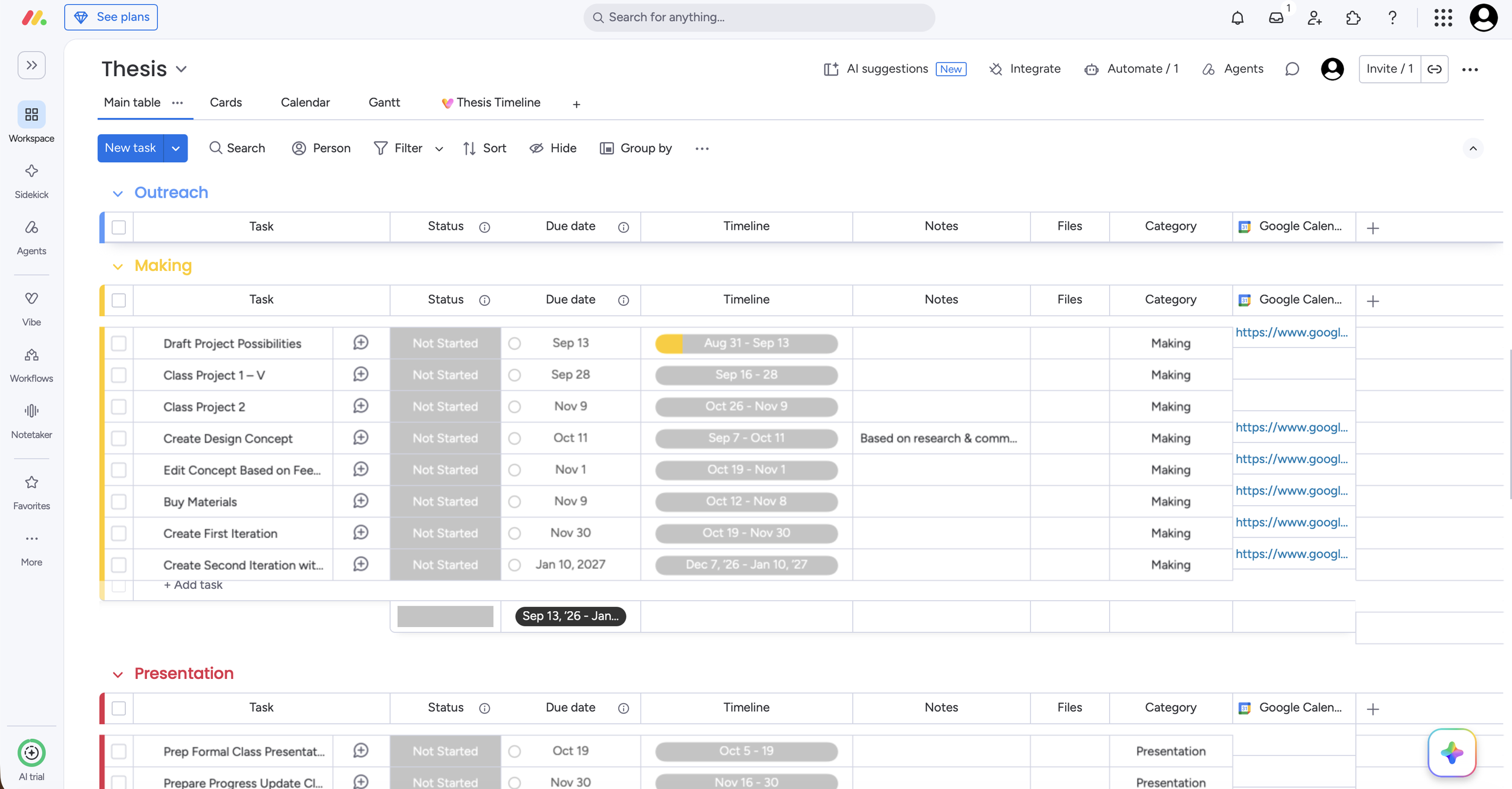
Not so glamorous, but I created a planning schedule for my entire thesis on Monday.com, using the Google Calendar integration feature. Since I currently plan most of my life on Google Calendar it needed to connect somehow!
This was a good exercise in chunking out what my project will actually look like and considering how long deliverables will take to make. I made this timeline while trying to factor in extra time — and realizing that things will still likely take longer than what I already think is enough time.
I’ve broken my timeline down into Planning, Research, Outreach, Making, Exhibition, Presentation, Writing, and Graduation. I can add tasks and subtasks to each of these categories as the thesis continues on.
For now, I have a rough outline of when large things need to be accomplished by, when I need to be starting on the next step, and graduation deadlines to keep in mind so I can hopefully get a diploma once all is said and done!
Introduction to Monotyping
This semester I’m taking Intaglio and Monotype, my first class ever working with ink and a press. I got into the studio and created my first study monotypes, getting myself familiar with the materials and process. I tried darkfield, lightfield, and stencil techniques, including found objects (a leaf).
Our first project is themed around myths and legends. I’m planning my project around a story from my grandma. Once, when she was young, she believes she and her siblings saw a “white animal” in the woods near where they lived out on a farm in southern Iowa. They heard a terrifying loud shriek and ran home as fast as they could. Neighbors also spoke of seeing this “white animal.” They didn’t identify what it was. They considered it maybe an animal escaped from a traveling circus, or something living out in the state forest nearby… but they never knew for sure.
I want to imagine what the white animal might have been. I plan to use paper stencils to create silhouettes for possible beasts, including a fox, a cougar, a lion, a barn owl, an elk, and a howler monkey. I am especially interested in trying these stencils as darkfield monotypes, displaying the white animal in white and using the colorful “background” to display multiple elements.
I’m focused on perspectives from and perceptions of rural places, especially through storytelling. Each of the artists I researched for this project is deeply connected to specific places, and their work reflects that connection. Each of their methods of expressing this connection to a place in time: color, wild pigments, stenciled symbols, layers, textures, found objects, play of light, and plein air monotyping have all given me ideas as I continue to try to capture a specific place, a specific time, and a specific story through my work.

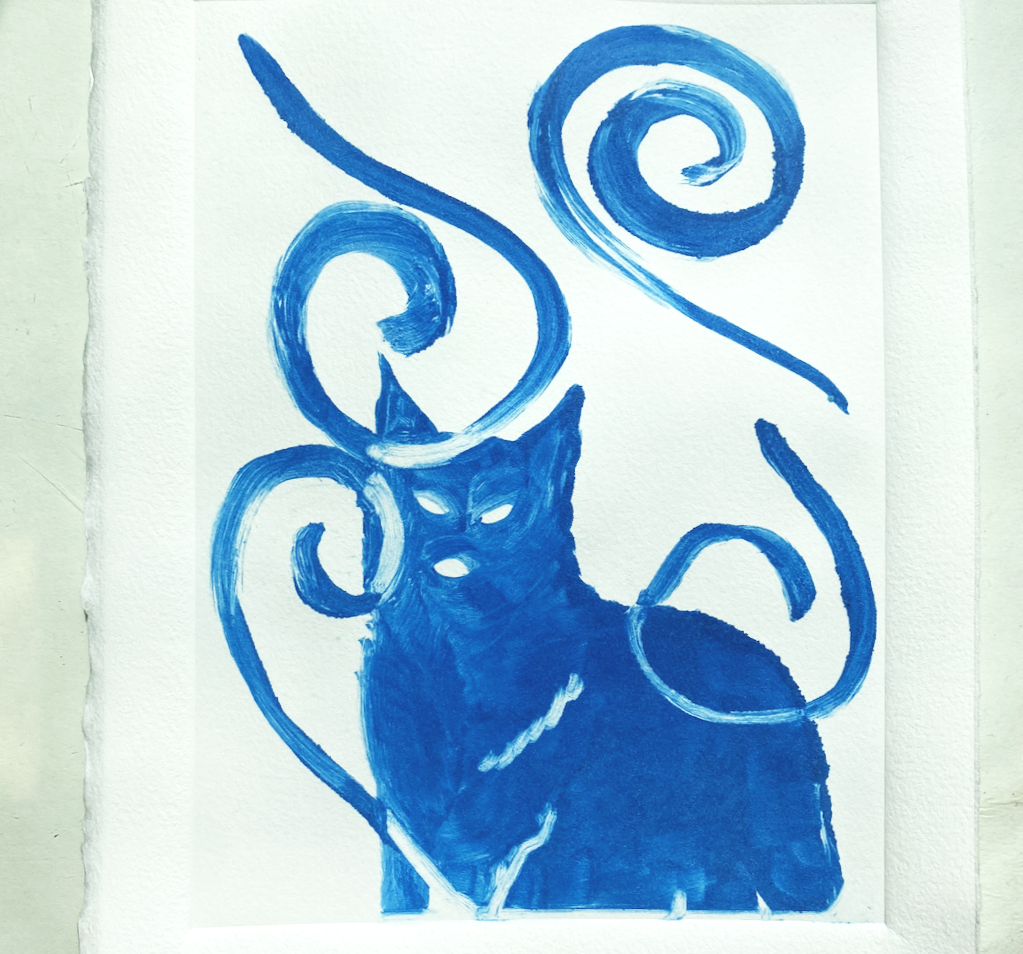
Little blue wolves
What I’ve Been Reading
Journal Articles
A Ladder of Citizen Participation
This article felt directly relevant to potentially working with a rural community on a project. It discussed a typology for determining different levels of actual citizen participation in decision-making:
Manipulation: “The distortion of participation into a public relations vehicle by power holders” (p. 26). For example, when officials use a “Citizen Advisory Committee” to educate, guide, and persuade the citizens.
Therapy: “Citizens are engaged in extensive activity, but the focus of it is on curing them of their “pathology” rather than changing the racism and victimization that create their ‘pathologies’” (p. 27). Used as distraction from dealing with actually important matters, instead tries to adjust people’s values to that of the larger society. Basically seems to blame problems on the people that aren’t in their control.
Informing: “Too frequently the emphasis is placed on a one-way flow of information — from officials to citizens — for no channel provided for feedback and no power for negotiation” (p. 27). Often in the form of news media, posters, pamphlets, etc.
Consultation: “Can be a legitimate step toward [citizens’] full participation…it offers no assurance that citizen concerns and ideas will be taken into account…What citizens achieve in all this activity is that they have ‘participated in participation’” (p. 28). Often attitude surveys, neighborhood meetings, public hearings.
Placation: “Citizens begin to have some degree of influence though tokenism is still apparent…if they are not accountable to a constituency in the community and if the traditional power elite hold the majority of seats, the have-nots can be easily outvoted and outfoxed” (p. 29).
Partnership: “Power is in fact redistributed through negotiation between citizens and power holders. They agree to share planning and decision-making responsibilities” (p. 30-31).
Delegated Power: “Negotiations between citizens and public officials can also result in citizens achieving dominant decision-making authority over a particular plan or program” (p. 31).
Citizen Control: “Participants or residents can govern a program or an institution, be in full charge of policy and managerial aspects, and be able to negotiate the conditions under which ‘outsiders’ may change them…no intermediaries between it and the source of funds is the model most frequently advocated” (p. 32).
Arnstein, S. R. (2019). A Ladder of Citizen Participation. Journal of the American Planning Association, 85(1), 24–34. https://doi.org/10.1080/01944363.2018.1559388
Other Media
A Patchwork Quilt - An Essay on Reframing Rural & Reframing Rural Podcast
I found the “Reframing Rural” project while looking for case studies about storytelling in rural places. Megan Torgerson is from rural Montana and started the "Reframing Rural” podcast while working toward her MFA in arts leadership. She interviews people from her home region of Montana as well as other rural locales throughout the country.
The podcast seeks to “share stories of people and places in rural America in an effort to celebrate culture, preserve history and cultivate curiosity and conversation across geographic, class and cultural divides” (Mountain & Prairie).
Meeting Notes & Things I’ve Learned
School for Rural Culture and Creativity
“Overlooked and undervalued for too long, we believe it’s time to invest in rural culture.”
Based in Matfield Green, Kansas, this transformed the building that used to be the community’s elementary school into a community gathering space with a gym, library, kids’ playroom, playground and open green, studios, kitchen, and exhibition space. Very inspiration use of built capital for cultural and social capital!
Josh Cox and Dawn Gettler are displaying tiny artworks created by Dawn and several other local artists in boxes, like Little Free Libraries, around Marshalltown.
Considerations:
could my project be archival? book, signs, etc?
potlucks?
where to do exhibition/defense - in a community I work with?
talk to community members. even think about recording voices, how people speak
what gives a person place attachment in a rural community?
Next Steps
This week I…
reached out to a potential community to work on a project with
found case studies around other rural storytelling projects
considered what I want to make and how that could blend with a specific community
Next up I will…
Draft questions for an initial community meeting
Draft potential project proposals, considering what I’ve read in the “Ladder of Citizen Participation.”
Reach out to schedule all committee meeting