❋
August 27, 2026Welcome to Anne’s Thesis Weekly!
Week 1Hello! Welcome to the first installment of my weekly thesis digest.
This was the first week of the semester (and my last first day of school).
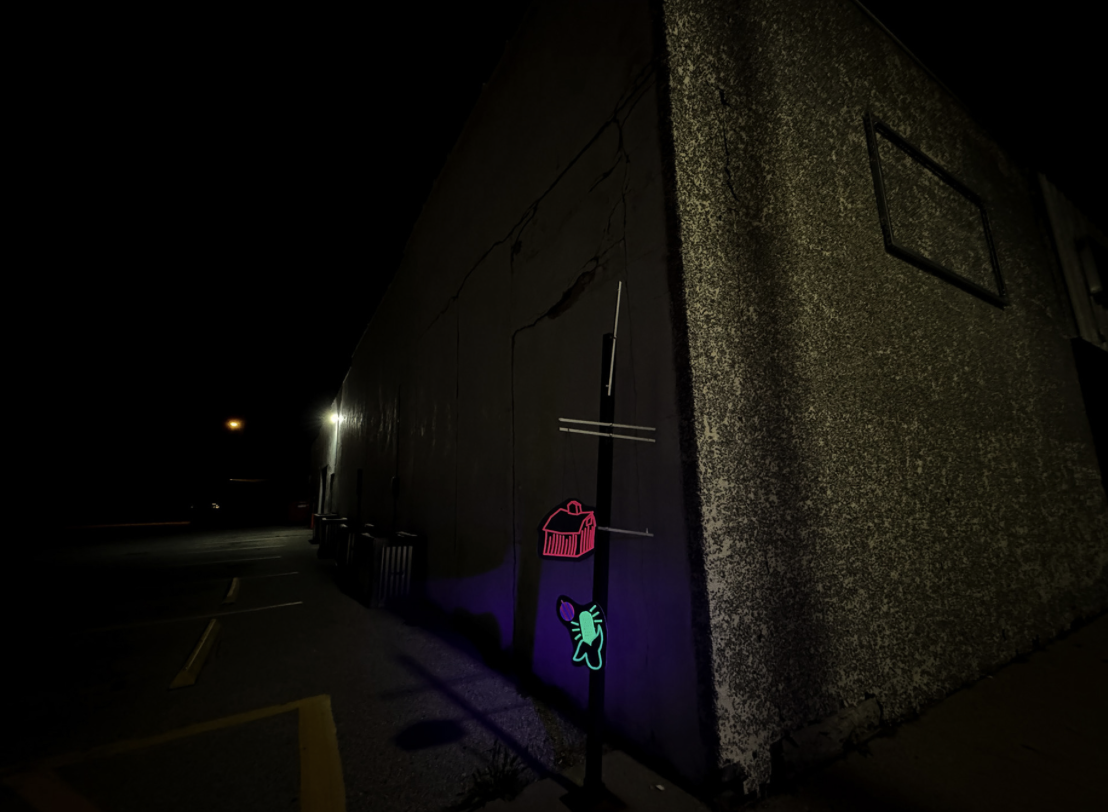
I stumbled upon a topic I was apparently secretly passionate about during my first semester of grad school when I created “neon” signs that I then hung up around empty buildings in a small town not far from Ames. I decided this was my way of adding life to these empty community spaces, and that awoke a slew of questions that I’d had since I was a kid growing up in rural Iowa: Why do we lose places we care about? Is this the way of progress? Is this inevitable? I had enough questions and kept thinking about it so much that I finally decided it gave me a thesis direction.
What I’ve Made
This week in class, I gave a quick summary of some of the projects I’ve made since then that have helped me explore ways to ask questions, collect data, and create around small Iowa communities and place attachment, starting with my own attachment to the places I call home. Reviewing these projects is helping me draw connections between them.
Scenes from a Small Town
Expressing my own place attachment
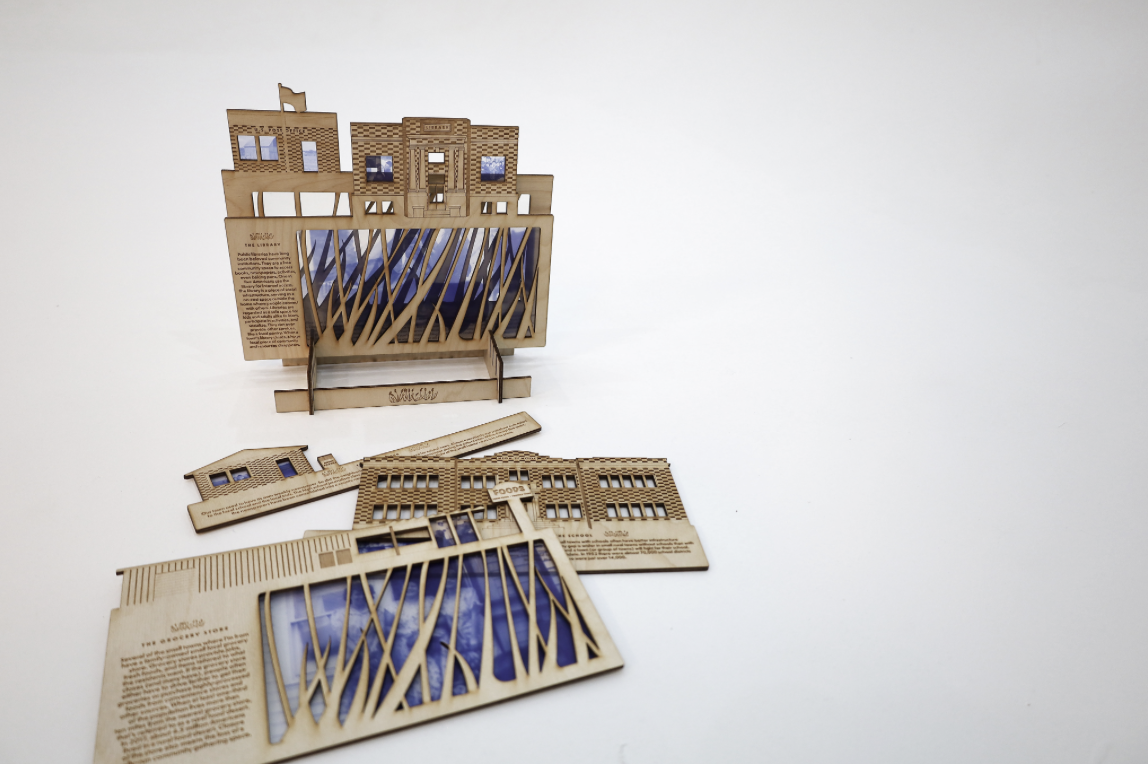
This project started with a question: What makes a community? What happens when community institutions close? I selected community landmarks familiar to me, such as a library, a grocery store, and a post office from nearby towns, as my “models." I designed and laser cut and engraved each, then set transparent photos of my grandparents from the 1930s-40s inside each buildings' frame to show the human side of this layered town. As a viewer removes a panel, they remove an important piece of the community.
Takeaways: This project helped me explore my own place attachment (before I knew what that was) through laser engraving familiar buildings and including family photographs. It was a very personal project that has brought good questions and interaction out of almost everyone who’s viewed it. It was complex to assemble, but the effort was worth it.
Slater Public Art Proposals
Design considering place attachment in a community
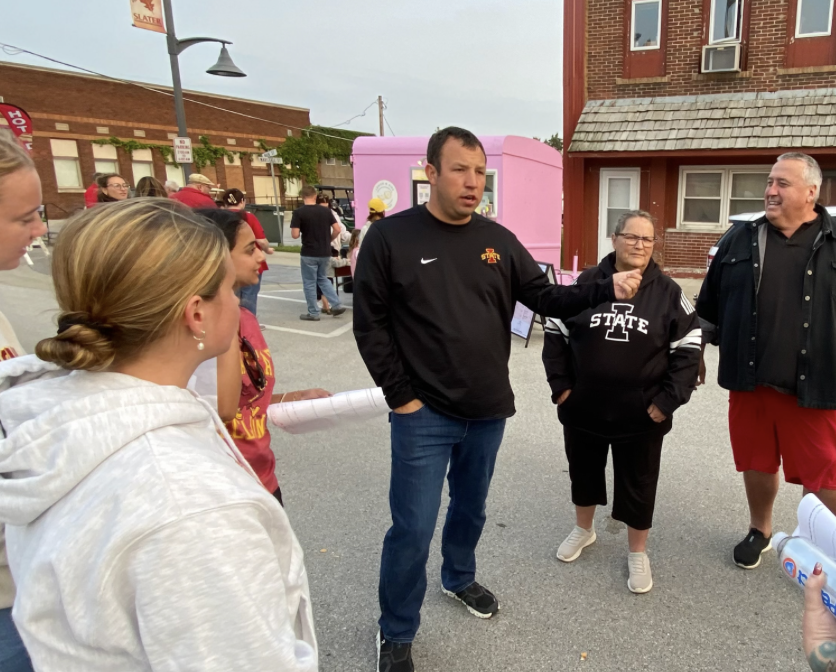
In Fall 2025, my Public Art/Public Space class with Jennifer Drinkwater partnered with the city of Slater to propose public art projects that could potentially also serve as solutions to issues people spoke with us about, such as traffic calming measures and attracting attention to Main Street. We began with researching Slater online, then attending a town tailgate event to chat with community members, then studying other public art initiatives to work toward presenting our own proposals to Slater at a meeting.
Takeaways: Working with a community who’s excited to embrace public art proposals, especially from students, is awesome! The relationship was established through our professor’s connections and strengthened through attending town events and meeting community leaders. I have to be real, I wasn’t sure they would take us seriously, but people showed up to our final presentations and were engaged with follow up questions. It was great experience to carry out this process from research to proposal.
Community of Design
Asking people how place attachment forms through interaction
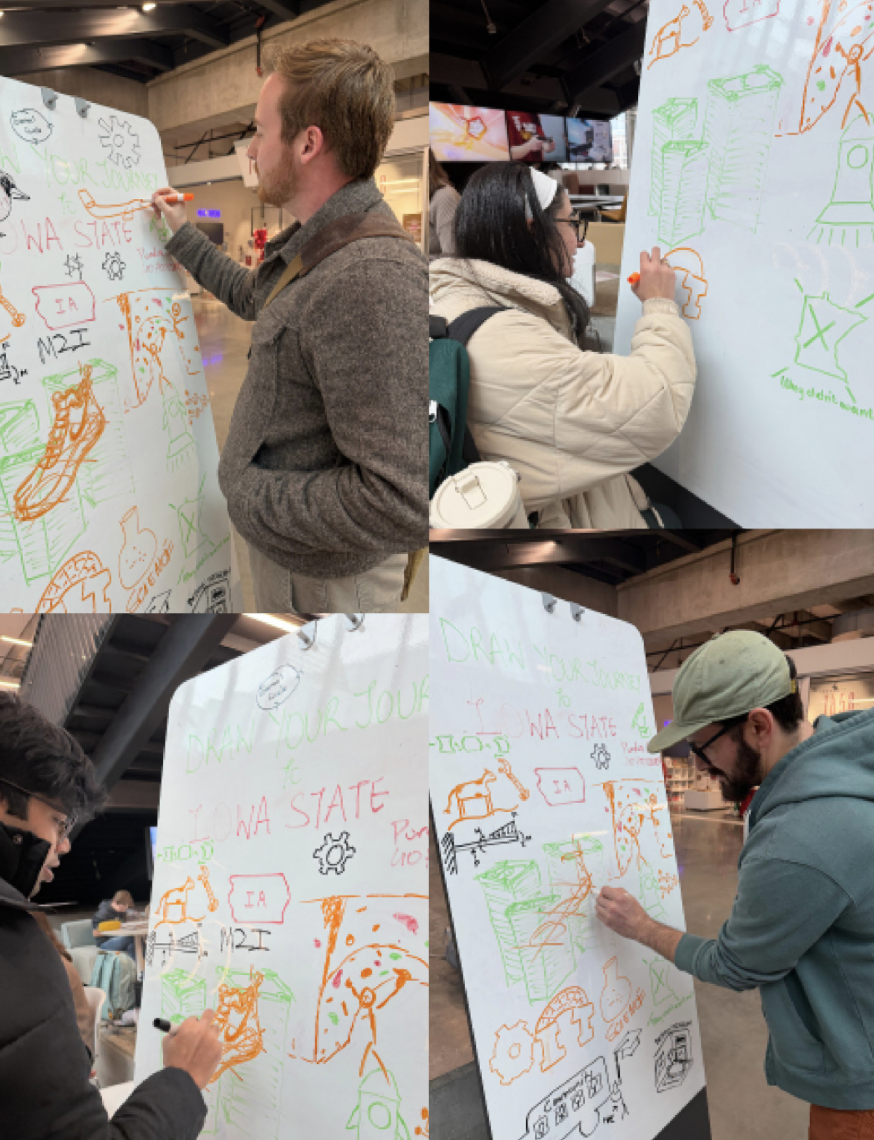
This was a collaborative project with Srishti Malhotra in which we explored community engagement with small Iowa towns as well as engaging people with ISU’s College of Design. This was a great way to test out creative community engagement activities with a small community (a group of ISU students) and get people thinking about why they choose a school and a community and what they feel their part in it is.
Takeaways: This was good practice with planning simple engagement activities and working with people to see what unpredictable insights and data come from conversations. As we created the workbook that went along with the project, I learned ways I don’t want to approach a community project. I felt the [theoretical] workbook put too much responsibility on community members for a problem caused by larger forces out of their control. I didn’t think of a better alternative at the time. This is an important takeaway as I work on my thesis project.
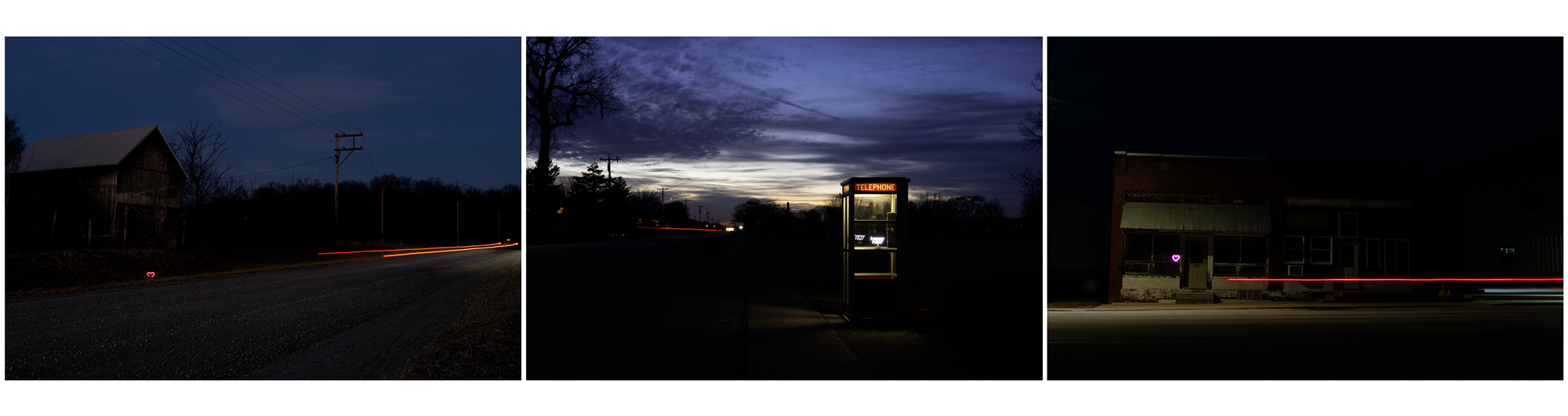

Photography: “Gone By” and “Long Way Around”
Exploring my own perspectives on/from rural places
Gone By: This digital photography series highlights rural structures that are empty or from times gone by and adds a little bit of life and love to them by placing neon signs in or around them. Taillight trails convey a sense of leaving and add another sign of human activity around these structures.
Long Way Around: Our society is car-centric, and interstate highways built over the last several decades have made it efficient to bypass many rural towns. How has this shift changed the rural communities that once served as main traffic thoroughfares? In this project, I layered black and white negatives in the darkroom, a map combined with an image of Main Street. Each presents a story of how a travel system shapes one of many small towns. The last of these compositions is overlaid with a vintage radio communications map of North America, zooming out to demonstrate how the highway system now stretches across the continent. This image of the town includes no real identifying features, suggesting it could be just any town in that stretch from coast to coast.
Takeaways: Photography is a versatile and meaningful way for me to explore place attachment. I learned how to stage photographs, use detail to convey emotions, and the physical process of developing film in the darkroom. Something about the physical process, the slow process that we can now cut out with digital photography, added dimension and a very personal feel to the photos for me that I also think speaks to my thesis interests – what is “progress,” and what do we lose with efficiency?
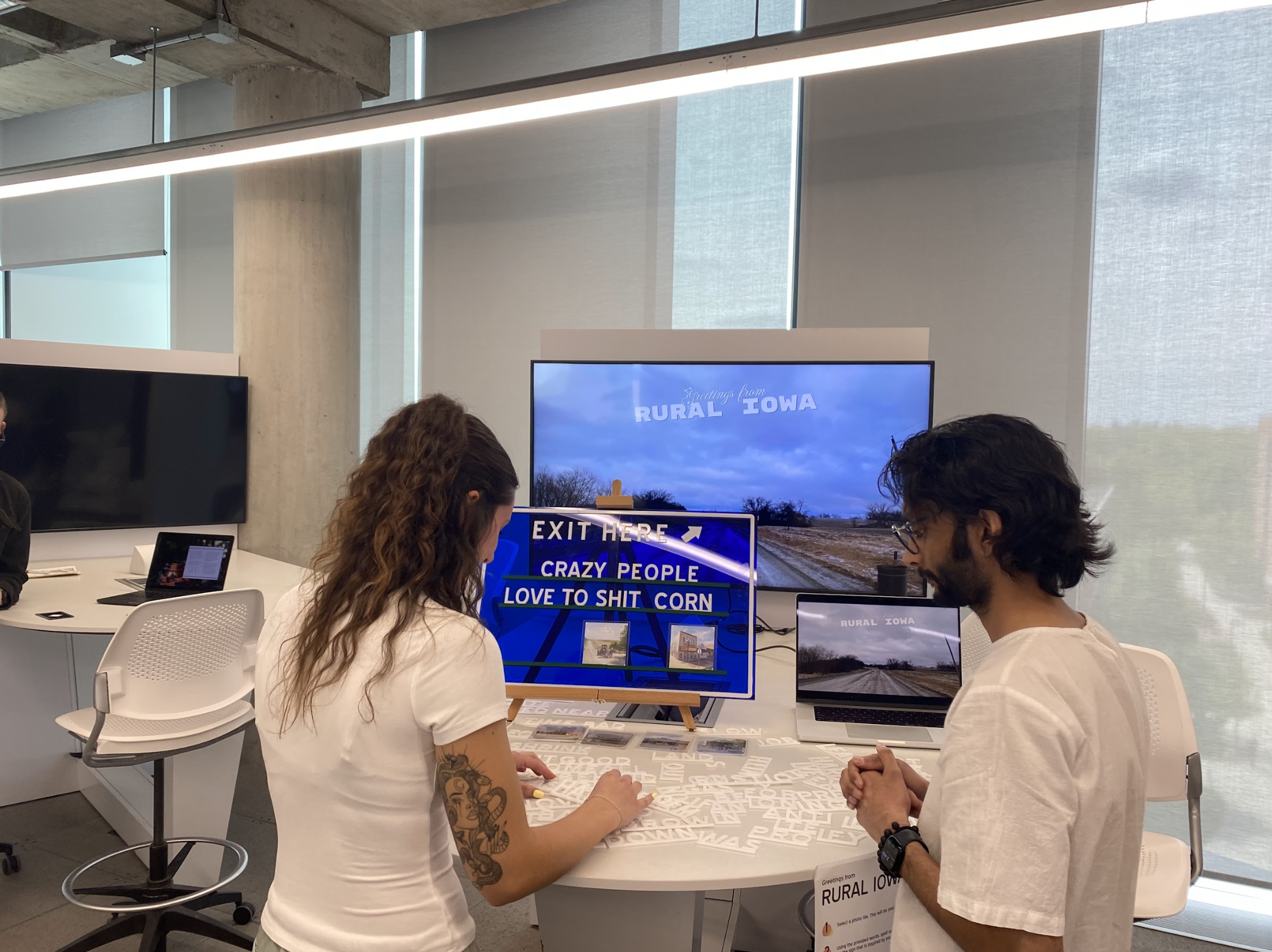
Alt-Urban Design Probe
Understanding (humorous) perceptions of rural Iowa
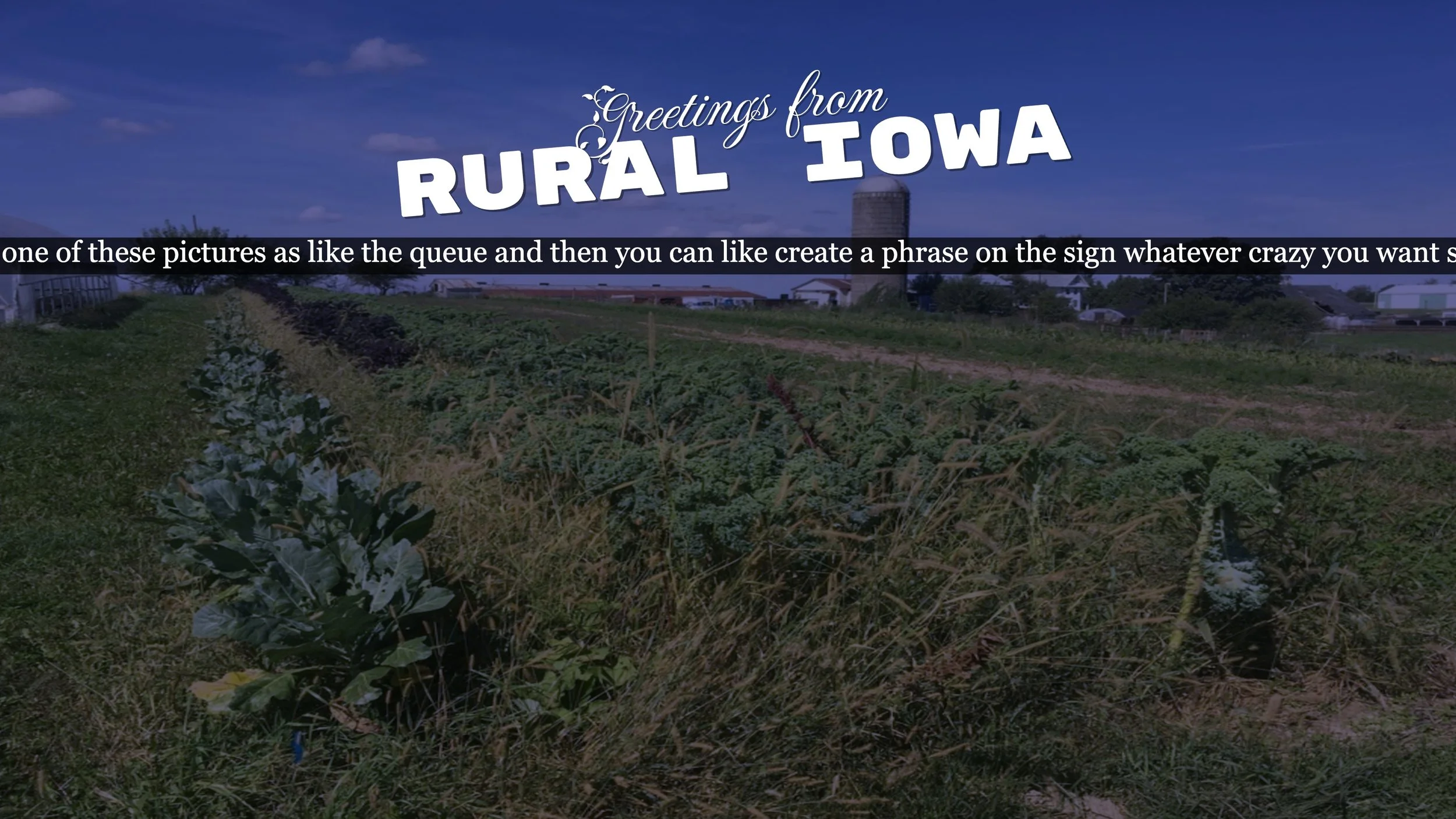
This project used an interactive probe to explore perceptions of rural Iowa using limited word and visual choices. I test ran it with the graphic design grads and a few faculty. A participant could select a photo tile, spell out their message that they associated with the tile, and then speak their message to the computer so a custom image would appear on the screen.
Takeaways: I loved the humor that was part of this project! People want to have fun & that’s how you engage them. I learned I enjoy collecting data through unpredictable activities with a small group of people. It also helped to put limits on responses. At first I was planning to make it open-ended with individual letters, but a classmate suggested limiting responses by providing only words and parts of words for people to string together. I think this made the interaction less overwhelming for participants while also adding an interesting challenge.
What I’ve Been reading
Journal articles
Selected quotes:
"Rural people are generally not perceived as rich sources of potential innovation, but instead as a problem to be solved or to be designed away" (p. 37).
"What could it mean to shift rural areas from the periphery to the center of design?” (p. 37).
My Notes: This paper was focused more on the field of HCI in rural spaces, but it struck a chord with me – finally, not talking about what rural areas lack in comparison with the urban and instead favoring an approach of what we can learn from rural places and people. I want to build on this concept with my thesis.
The paper also points out how urban centers’ needs and perspectives are commonly emphasized in design and encourages the reader to consider what matters in designing for rural communities. This could be a takeaway for my thesis: if I work with a rural community on a project, how can it emphasize rural perspectives?
Reference: Hardy, J., Phelan, C., Vigil-Hayes, M., Makoto Su, N., Wyche, S., & Sengers, P. (2019). Designing from the rural. Interactions, 26(4). https://doi.org/10.1145/3328487
Playing with Rural Design: Design Probe Failures & Community Disconnections
Selected quote:
“Existing sociotechnical systems designed for experiences of place are biased toward urban regions or do not reflect rural realities…many of our approaches to design and research have either yet to be rigorously tested in rural communities or need to be modified for use in rural areas” (p. 339).
My Notes: The authors of this paper designed a variety of probes to collect data from community members in select rural areas of the northern United States to understand Internet connectivity experiences. For me, the most fascinating portion of this paper was the authors’ analysis of why their first round of design probes failed. One participant is reported as calling the probes “’a little woo woo’” (p. 346). Other issues included participants having tech difficulties, trouble fitting the project into their schedule, unfamiliarity with the study leaders, or “concerns that misrepresentation would strengthen negative stereotypes” (p. 348).
Several helpful recommendations are included around logistics planning, building relationships, co-creating probes with participants, and recognizing “rural consciousness, rural narrative fatigue, and the harm of misrepresentation” (p. 348).
Reference: Jean Hardy, Megan Gleason, and Ava Francesca Battocchio. 2025. Playing with Rural Design: Design Probe Failures & Community Disconnections. Proceedings of the 12th International Conference on Communities & Technologies.
Other media
I’ll keep taking a closer look at this, but this is a book created to asset map a community in LA that was being covered negatively in the news. An artist was hired to create this collection of stories and photos to highlight assets in the community. While not centered on a rural community, I found this inspirational as a sort of community record project.
Reference: Rosten Woo. (2013). Willowbrook. https://www.arts.gov/sites/default/files/Willowbrook-full-book.pdf
I’ve begun subscribing to this Rural Organizing newsletter, and there was a gem section from this post that I want to log here to remember to keep in mind with my thesis (it’s a long quote but I don’t want to lose track of it):
I have talked with thousands of rural voters over the last decade. When you ask them what they want their community to look like in twenty years, almost all of them say the same thing.
“Like it does now.”
It does not matter where you ask. New subdivisions in wealthy exurbs. Distressed coal towns in Appalachia. Farm counties in the upper Midwest. The answer comes back the same. People want the place they live in to remain recognizable to them.
For many of us in Rural America, change is the threat. The “bad change” is obvious, because more unemployment and more addiction and more crime take a wrecking ball to quality of life. But we’re skeptical of “good change” too. Ask anybody who watched their kid get priced out of the town or neighborhood they grew up in once good things started to happen.
Most of the folks I talk to actually like the dive bar. They like the empty lot across the street where the neighborhood kids play football, and they would prefer for it to stay empty rather than someone build a fancy condo there. But more importantly, especially in this economy, they would like health care, child care, and elder care to cost less, the school to stay open, and their grandkids to be able to afford a house in town.
In Rural America, we’re taught to protect what we have. Preserve what works. And be suspicious of anybody who shows up with a vision of the future we did not ask for. But for the big tech-funded think tanks in Washington, D.C., growth and innovation are taken as gospel.
Progress and innovation are beautiful things for those who will benefit, and Ezra Klein isn’t being asked to sacrifice anything in his 2050 vision of a techno-utopia in which Rural America has been “rewilded” and rendered obsolete.
I worry “big thinkers” in the big city, especially those with Abundance-Brain, don’t realize that in Rural America, we don’t see ourselves in Ezra Klein’s vision for the future. Our only representation in his future is hosting the data centers powering his AI robots, or being erased—rewilded—altogether.
Candidates do not have to agree with our rural perspective. But they cannot win if they don’t take it seriously.
Hildreth, M. (2026, August 13). All Politics is Local: Why Abundance Movement Campaigns Are Failing to Connect with Rural Voters on Data Centers. RuralOrganizing. https://ruralorganizing.substack.com/p/all-politics-is-local-why-abundance
Up next
I’ve been doing some background research on a specific rural community in Iowa as a way to scope out its situation and if it would be a potential project partner. Research includes a population & demographics assessment, a visual assessment, and understanding the community’s assets (as presented online).
Based on feedback during my thesis introduction & progress presentation in class this week, it would be a good idea for me to have some project parameters in mind if I do approach this community about a partnership. I don’t necessarily need to have a specific project laid out for them – I would want to work with the community on it – but it would be helpful to have a scope and ideas to propose.
I also got feedback to keep in mind these ideas:
Rural communities face certain disadvantages by design. Rural “decline” is not a natural or inevitable process. This suggests there are solutions.
Front porches were traditionally gathering spaces that were upended with houses being designed with garages on the front. Then people moved gatherings to the garage. How does what seems like a simple or efficient design choice shape our lives, but also how do people adapt so they still connect with one another?
One classmate recommended getting in touch with IDRO at the College of Design — they do a Mayor’s Design Workshop each year with Iowa communities.
During the next few weeks, I plan to:
Meet with my major professor
Create my thesis project timeline
Wrap up my online assessment of the community
Begin planning project parameters & proposals